
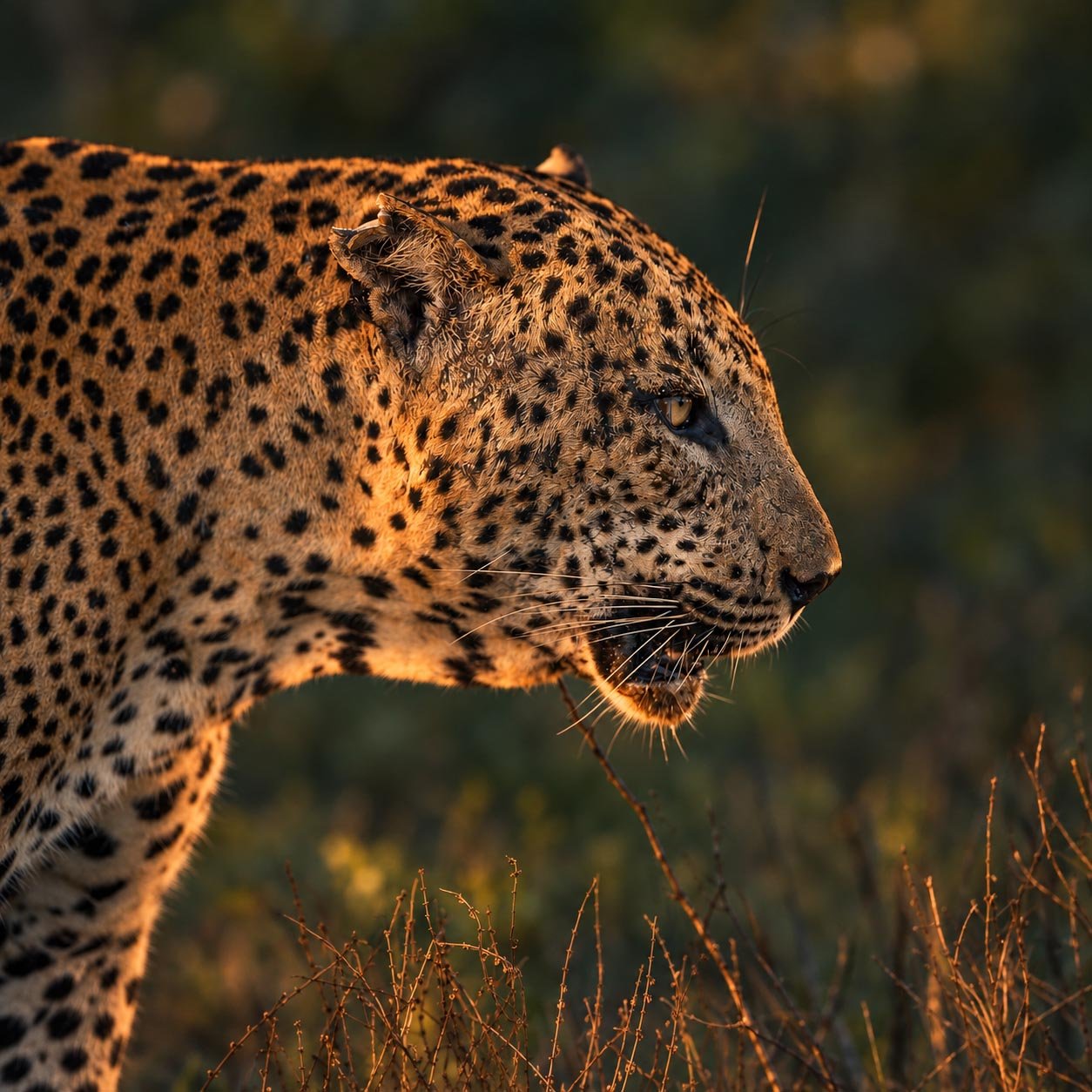
Nilame (YM61): The Battle-Tested Leopard of Yala National Park
Nilame (YM61) is a mature male Sri Lankan leopard (Panthera pardus kotiya) living in Yala National Park, Sri Lanka. Estimated to be around eight years old, he is recognised by his strong build, weathered appearance and the visible scars on his face—marks of a demanding life in one of the world’s most competitive leopard habitats. Yala National Park is internationally known for its high density of leopards and offers an exceptional opportunity to observe these elusive big cats in their natural habitat. Yet, for male leopards such as Nilame, survival is not guaranteed. Territory, prey, rival males and breeding opportunities all shape their lives.
Nilame’s Early Years With Sandy (YF07)
Nilame was first documented in 2021 with Sandy (YF07), believed to be his mother. At that time, Nilame was estimated to be around one and a half years old. During his early life, he was rarely seen, often remaining hidden in thick vegetation. Under Sandy’s protection, Nilame learned the skills that every leopard needs: moving quietly through the forest, locating prey, recognising danger and avoiding the territories of powerful adult males. As he grew older, sightings of Nilame became more frequent around Maila Wala, Koma Wewa and Kaluwara Bokkuwa. These observations showed a leopard gradually becoming independent and learning to survive alone.
A Difficult Life in Yala’s Male Leopard Territories
By 2023, Nilame was regularly moving through new areas, hunting independently and searching for his place within Yala’s leopard landscape. In early 2024, he began travelling towards Kotasiyabala, where established male leopards held influence. This was a dangerous stage in his life. Adult male leopards defend important areas, and younger or unfamiliar males can face serious confrontations. Nilame reportedly encountered the powerful Pan Wala Male during this period. Following the encounter, scars were visible on Nilame’s face. These are not merely signs of a fight; they represent the reality of life for a male leopard in Yala. Years of conflict, long journeys, competition for food and constant territorial pressure can make a leopard look older than his real age. Nilame’s appearance reflects the hard life he has survived.
Nilame and Lucas (YM16): A Rare Peaceful Relationship
One of the most interesting recent observations involving Nilame is his tolerance of Lucas (YM16), a well-known dominant male leopard of Yala. In June 2026, Nilame and Lucas were observed feeding from the same sambar deer carcass. Such behaviour is uncommon between adult male leopards, especially around a large kill, where competition is usually intense. Their peaceful behaviour was observed again on 5 September 2026. Nilame and Lucas were seen resting in the same area, sleeping nearby and later walking together. These sightings do not mean that the two males have abandoned their territorial nature. Leopards are powerful, mostly solitary wild animals, and their behaviour can change according to prey availability, female leopards, territory and the presence of other males. However, these moments reveal that leopard behaviour is more complex than constant conflict. In the wild, survival may also depend on patience, tolerance and knowing when avoiding a fight is the wiser choice.
Nilame’s Continuing Story
Nilame’s journey from Sandy’s cub to a mature and battle-tested male leopard is a powerful example of resilience in Yala National Park. His scars tell a story of encounters, endurance and survival. His peaceful interactions with Lucas offer a rare and valuable insight into the changing social behaviour of male leopards. Nilame’s future, like that of every wild leopard, remains uncertain—but his story continues to unfold in the heart of Yala. Wildlife observations are based on recorded sightings. Leopard behaviour can change naturally over time, and all animals should be observed responsibly without disturbance.
Frequently Asked Questions
Who is Nilame (YM61)?
Nilame, identified as YM61, is a mature male Sri Lankan leopard recorded in Yala National Park.
How old is Nilame?
Nilame is estimated to be around eight years old. He was first documented in 2021, when he was estimated to be around one and a half years old.
Who is Nilame’s mother?
Nilame has been documented with Sandy (YF07), who is believed to be his mother.
Where can Nilame be seen in Yala National Park?
Nilame has been recorded around Maila Wala, Koma Wewa, Kaluwara Bokkuwa, Kotasiyabala and neighbouring areas of Yala National Park.
Why does Nilame look older than his age?
Territorial pressure, long movements, injuries and competition with other male leopards may contribute to Nilame’s weathered appearance.
What was special about Nilame and Lucas?
In June 2026, Nilame and Lucas were observed feeding from the same sambar deer carcass. On 5 September 2026, they were again seen resting in the same area and walking together—rare observations for two adult male leopards.