
A Dark Chapter in the History of Yala National Park
Today, Yala National Park is internationally recognised for its extraordinary wildlife, particularly its leopards, elephants and sloth bears. Thousands of visitors travel to Yala every year to experience its wilderness and stay in its famous wildlife bungalows. However, behind this peaceful landscape lies a disturbing chapter of history that many visitors have never heard about. Between 1996 and 1997, several wildlife bungalows in Yala National Park were attacked and deliberately set on fire by armed groups suspected of having links to the Liberation Tigers of Tamil Eelam (LTTE). Tourists were threatened, wildlife employees were abducted, fishing communities suffered heavy losses, and the security of the entire national park became a serious concern. Historical reports published by The Sunday Times on September 21 and November 9, 1997, provide detailed accounts of these incidents.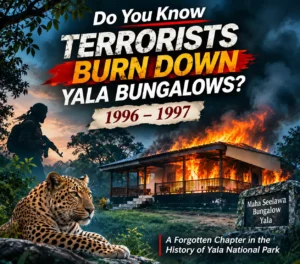
THE FIRST ATTACKS – JUNE 1996
The violence began in June 1996 when armed men entered Yala National Park and set fire to the Thalgasmankada and Yala wildlife bungalows, located near the Menik Ganga along the boundaries of Block 1. These remote buildings were surrounded by dense forest and accessible through limited roads, making them particularly vulnerable. In October 1996, another bungalow at Patanangala was attacked. Around the same period, four wildlife trackers were abducted. According to the September 1997 newspaper report, their whereabouts remained unknown at the time of publication. The incidents created growing fear among wildlife officials, tourists and communities living around the park.
SEPTEMBER 13, 1997 – THE NIGHT MAHA SEELAWA BUNGALOW BURNED
One of the most frightening incidents occurred on Saturday, September 13, 1997, at Maha Seelawa Bungalow, situated near Yala’s southern coastline. Police Inspector H. A. Guneratna, then Officer-in-Charge of the Bulathsinhala Police Station, was staying at the bungalow with members of his family. At approximately 8:00 p.m., Guneratna returned from a walk along the beach and discovered that heavily armed men wearing camouflage clothing had taken control of the bungalow. His family members were being held under armed supervision. There were reportedly eight attackers carrying automatic weapons and hand grenades. They demanded identity cards and questioned the occupants about their occupations. Fortunately, Guneratna was not carrying his official police identification. Realising the danger, he introduced himself as a textile merchant from Horana. According to his account, one attacker spoke Sinhala while others occasionally communicated in Tamil. The armed men searched the bungalow, taking money, jewellery, a camera and food supplies. The bungalow keeper, Jayatilleke, was questioned about routes through the national park. One of the occupants reportedly noticed an LTTE insignia on a map carried by the attackers.
MAHA SEELAWA BUNGALOW SET ON FIRE
After searching the building, the attackers gathered furniture inside the main hall and used petrol bombs and explosive materials to set the bungalow on fire. Within moments, the peaceful wildlife accommodation was engulfed in flames. The attackers then took the bungalow keeper and the visitors’ van before leaving. Guneratna and his family, including his eight-year-old daughter, were stranded in the wilderness without transportation. With the assistance of a wildlife tracker, they escaped on foot through the forest and eventually reached the wildlife office at Palatupana. The abducted bungalow keeper was subsequently released. However, the attackers did not stop at Maha Seelawa. They reportedly travelled to Buttuwa, where they set fire to both the old and new wildlife bungalows. By the following morning, three additional bungalows had been destroyed in a single night.
PATANANGALA – FISHERMEN ALSO BECOME TARGETS
The attacks were not limited to wildlife bungalows. In July 1997, approximately 75 fishermen were staying in temporary shelters at Patanangala while engaged in lobster fishing. One evening, around 30 armed men entered the fishing camp, gathered the fishermen inside a hut and ordered them not to escape. The attackers then destroyed 28 fishing boats and several temporary shelters by setting them on fire. Although no one was physically injured during this particular incident, the fishermen suffered significant financial losses and were forced to abandon their activities. For families depending entirely on fishing, the destruction was devastating.
WILDLIFE OFFICERS WORKING UNDER THREAT
Throughout this period, wildlife employees continued their duties under extremely dangerous conditions. Remote bungalow keepers and trackers were particularly vulnerable because of the isolated nature of their workplaces. The disappearance of four wildlife trackers in 1996 was among the most disturbing incidents reported during this period. There were also reports of landmines in surrounding forest areas. One man lost a foot after stepping on a landmine while assisting with the recovery of the bodies of two villagers reportedly killed inside the forest. These incidents demonstrated that even the people responsible for protecting Yala’s wildlife were not safe from the consequences of the country’s civil conflict.
WAS THE LTTE RESPONSIBLE?
Eyewitnesses strongly suspected that the armed attackers belonged to the LTTE, citing their weapons, organisation, language and reported possession of LTTE insignia. Some security personnel shared this suspicion. However, contemporary newspaper reports indicate that the authorities had not officially confirmed the identity of the attackers. The distinction remains important when documenting historical events. Although the attacks and destruction were reported, the responsibility attributed to the LTTE was not conclusively established in those contemporary accounts.
MILITARY SECURITY INTRODUCED IN YALA
Following the attacks, security within Yala National Park was significantly strengthened under Brigadier Shiran Ranatunga, who oversaw security arrangements as the competent authority. Military camps and security posts were established at strategic locations, including areas close to destroyed wildlife bungalows. Visitors entering through Palatupana underwent security checks, while armed patrols monitored sections of the park. The Army also conducted searches through the forests towards Kumbukkan Oya, although the suspected attackers were not located. Despite these measures, the vast wilderness, remote coastal areas and difficult terrain made security operations extremely challenging.
NOVEMBER 1997 – YALA BEGINS TO RECOVER
By November 1997, Yala National Park was gradually returning to normal following its annual closure and the security concerns. On November 2, approximately 30 vehicles entered the park, generating nearly Rs. 90,000 in entrance revenue. The Ondaatje Bungalow was available for reservations, while plans were underway to reopen Heenwewa and Palatupana bungalows. Authorities had also begun preparing estimates to reconstruct the damaged Buttuwa and Maha Seelawa bungalows. The return of visitors marked an important stage in Yala’s recovery, although the memories of the attacks remained with those who had experienced them.
A HISTORY THAT SHOULD NEVER BE FORGOTTEN
Today, Maha Seelawa, Buttuwa, Thalgasmankada and other wildlife bungalows are associated with peaceful nights in the wilderness, remarkable wildlife encounters and unforgettable experiences. Yet these same locations once witnessed armed attacks, destruction and terrifying moments for visitors and wildlife employees. The escape of Inspector Guneratna and his family, the abduction of wildlife trackers, the burning of bungalows and the destruction of fishing boats are all part of Yala’s history. A decade later, on October 15, 2007, another deadly LTTE attack occurred in the Thalgasmankada area, once again reminding the country of the dangers faced by those working within the national park during the civil war. Yala is not merely a sanctuary for wildlife. It is also a landscape that carries the memories of people who served, protected and survived some of the most difficult periods in Sri Lanka’s history.
The forests have recovered. The wildlife continues to thrive. Visitors have returned. But the stories of the bungalows that once burned in Yala must never be forgotten.